The Real Cost of the Suburban Rail Loop: What the Latest Audit Tells Us
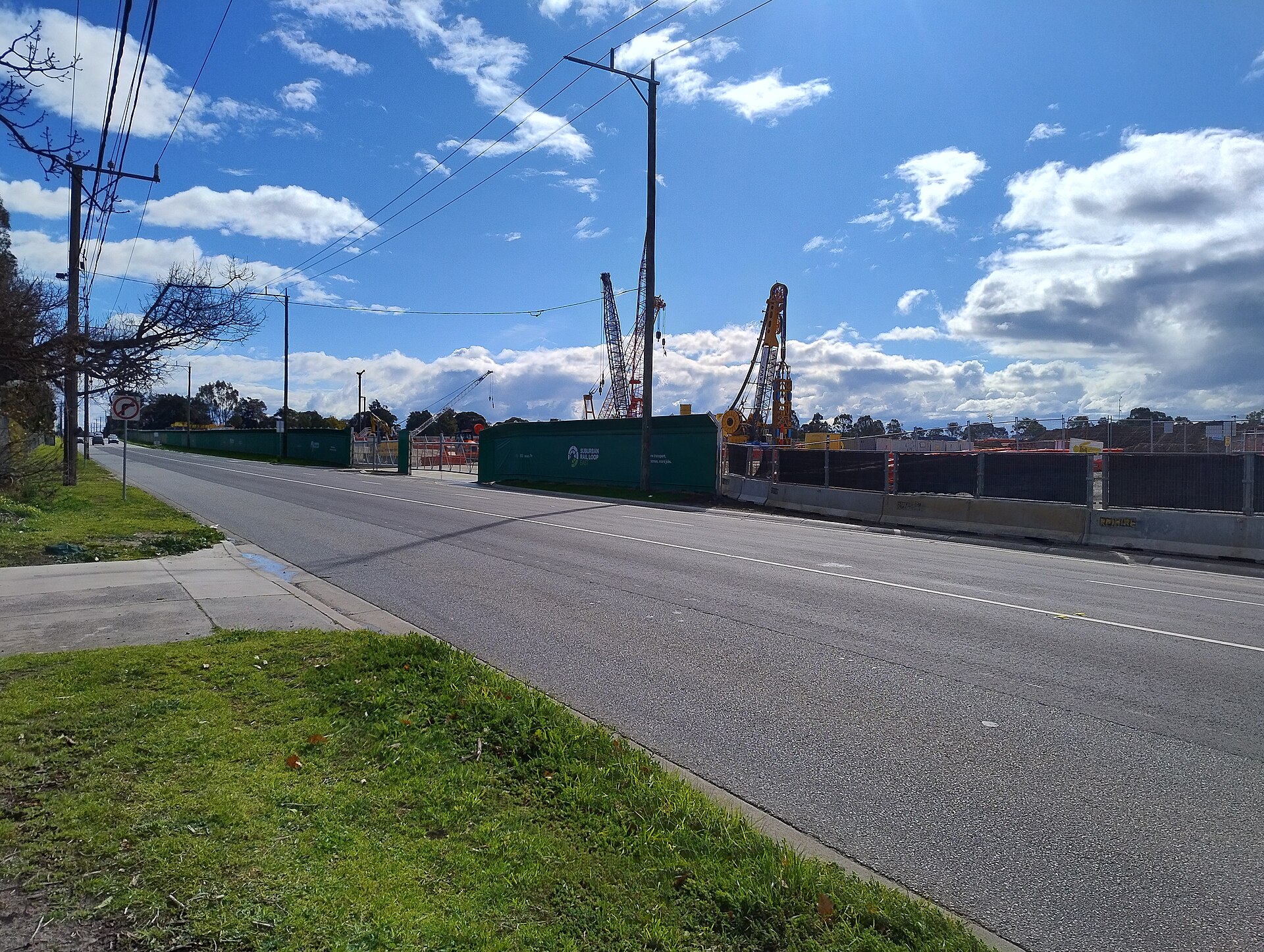
The published cost of Suburban Rail Loop East is up to $34.5 billion. The Auditor-General’s analysis, based on evidence to the end of 2025, puts a potential final cost of more than $36 billion, and concludes the project is more likely than not to exceed the published figure. Neither number covers everything: the published estimate excludes several works and contracts the government has not yet funded. The photograph is a train stabling facility and maintenance depot under construction between Southland and Clayton stations in August 2025. It is early works, not the tunnels.
Big Build’s pages, read in October 2026, still say construction of SRL East is under way, tunnelling has started, and trains will be running in 2035. That is the authority’s position. The audit, tabled on 26 August 2026, reaches different conclusions on both cost and schedule. This story is about how those numbers fit together, and what each one measures.
What the published cost measures
The 2026–27 state Budget puts SRL East at between $30 billion and $34.5 billion. The upper figure was rounded up from $34.4 billion, and it excludes about $300 million of initial development costs, approved in the 2019–20 Budget, for the business case, design and pre-construction work. The audit compares three estimates for the same components:
| Component | Government estimate 2021 | SRLA budget, December 2025 | VAGO potential outturn |
|---|---|---|---|
| Initial and early works | $2,200m | $2,200m | $2,220m |
| Main works | $30,692m | $30,692m | $32,338m |
| Precinct development works | $1,515m | $1,520m | $1,520m |
| Total | $34,407m | $34,412m | $36,078m |
The figures are nominal. VAGO’s potential outturn sits about $1.7 billion above the authority’s own budget, mainly because the audit includes known cost increases the December 2025 budget did not: expected procurement outcomes for the two stations packages, on advice, by more than $1.0 billion, and a higher contract cost for the line-wide package.
The published estimate also leaves out a set of costs the audit lists separately. None of them is in the $34.5 billion:
- about $1.7 billion for station interchange works connecting the new underground stations with the existing stations at Southland, Glen Waverley and Box Hill, of which at least $1.6 billion is not covered by the current budget
- $500 million to $750 million to acquire 21 strategic sites for future state-led property development and resale, the mechanism behind the value capture revenue target
- up to $425 million for voluntary purchase schemes for residential, commercial and business properties
- up to $53 million more for the Glen Waverley multi-level car park, an environmental approval condition, against the $84 million in the budget
- about $3.9 billion, nominal, for the first 15 years of the operation and maintenance franchise, signed in December 2025.
The interchange works show how scope and cost interact. In early 2026 the authority proposed building two of the three interchanges inside the SRL East budget, at a further cost of $647 million, and deferring the third to the future SRL North at around $950 million. By the end of the audit it was considering recommending only one of the three. The authority has also identified further costs, above $2.5 billion, for works and investments needed to achieve the benefits the government claims for the project. None of that is scandalous accounting; it is how the boundary of a project estimate works. It does mean the published figure and the whole cost of the policy are different things.
Where the estimate has already moved
Procurement has tested the 2021 estimates, with results the audit records plainly. The contract for early works package A nearly doubled, from $535 million to over $1 billion. The line-wide package, signed in December 2025 after 17 months of delay against a July 2024 target, carries a contracted target outturn cost of $6.7 billion, including a $353 million target cost to manage contamination at the Southern Stabling Yard. The stations packages are expected to exceed the authority’s 2024 estimates by 15 to 20 per cent because of rising construction costs.
A government decision made the numbers worse. In April 2024, to manage state debt, the government directed the authority to delay about $1.4 billion of spending beyond the budget forward estimates. The authority advised in August 2024 that delaying early-stage works would increase the final cost by around $1 billion, most of it escalation from paying later at higher labour and material rates, and that it could reasonably defer only $800 million. It did not meet the $1.4 billion target: the audit’s analysis has it spending around $874 million more than the pre-direction profile in 2023–28. In December 2025 the authority advised that bidders for the stations and line-wide packages had raised prices to cover the uncertainty about when the state would want the work done. The direction increased cost and risk without achieving the spending reduction it was designed for.
Contingency, and who carries the risk
The authority’s estimates for the early and main works include $9.5 billion of contingency, 29 per cent of the $32.9 billion package total. A significant portion is already spent or committed, and the audit is unclear whether what remains is enough for the known threats, which include contamination and the interfaces between five interdependent works packages. The authority maintains it has sufficient contingency. On the audit’s evidence, that claim is a management position, not a finding.
The contract structures matter as much as the contingency. The main packages are incentivised target cost, reimbursable, or alliance contracts. None is fixed price: each has a target cost that can be adjusted for risks and unforeseen circumstances. On those contracts, the state, not the contractor, largely carries the risk of rising labour and material costs.
Funding: two approved legs and a softer one
The funding plan has three streams of about $11.5 billion each: the state Budget, the Australian Government, and value capture. Approved funding as at June 2026 is $29.3 billion, about 85 per cent of the estimate: $23.3 billion approved from the state, of which only $11.8 billion was publicly announced at the time it was approved, and $6 billion committed by the Commonwealth against an expected contribution of about $11.5 billion. The audit records a $5.5 billion gap in approved funding at June 2026, and notes that the state approved a further $11.5 billion in December 2023 without announcing it or clearly disclosing it in the budget papers; the borrowings were confirmed publicly two years later, when the value capture package was announced in December 2025.
The value capture leg is the part with the most uncertainty. The five measures announced in December 2025 are existing land tax and windfall gains tax revenue in the precincts, infrastructure contributions from developers, a car parking levy from 2035, and profits from state-initiated property development. Alongside them sits the project’s largest single measure, which was never announced with the others: since 1 January 2025, every public transport fare in metropolitan Melbourne and regional Victoria has risen by an additional 1 per cent a year on top of the usual CPI increase. The government plans to allocate 60 per cent of that revenue, estimated at $4.8 billion in net present value terms to 2062, to SRL East. The audit finds the levy is not fully consistent with the state’s own 2017 value capture framework, because fare payers contribute more than any other group and some may never use the line, and that hypothecating existing land tax revenue is effectively an extra contribution from the state Budget. Revenue collection runs over 40 years and depends on future governments keeping the measures.
The precinct-based parts of the model face the same constraint the activity-centre programs face: the revenue depends on developers choosing to build. The audit notes investors already face challenging market conditions, which puts both the expected housing and employment benefits and the value capture revenue at risk.
The 2035 date
The audit’s schedule conclusion is blunter than its cost one: the government is unlikely to meet its public commitment to run train services through SRL East by 2035. The recorded delays are an early works package at least six months late, with oil pipeline relocation now expected in February 2027 rather than July 2025; the southern tunnels package at least two months behind on ground conditions; line-wide procurement 17 months late; and stations procurement at least 12 months late, with the southern stations award not expected before the first half of 2027.
The line-wide contract requires completion in May 2035. The authority carries about seven months of schedule contingency and is forecasting services from 31 December 2035. In December 2025 the Department of Premier and Cabinet advised that if the preferred contractor for the southern stations package was not approved before the caretaker period for the 2026 state election, costs would rise across three work packages and services would be delayed beyond the end of 2035. The authority was still examining options to resequence the works when the audit closed; those options were not finalised or agreed with contractors, so the audit offers no assurance they will work.
How to read the numbers
Three figures now describe the cost of SRL East, and they are different kinds of object. The $34.5 billion upper estimate is the government’s published figure, rounded from $34.4 billion. The authority’s December 2025 budget sits at almost the same number. VAGO’s $36 billion is an independent assessment of likely outturn, not a budget decision. The project page records the published figure, with its source and date; this story records the audit’s assessment beside it.
The useful test for any future SRL cost report is which of these it is quoting, and whether it counts the excluded works. A project that ends up spending $34 billion will have come in “on budget” while still costing more than $40 billion once the interchanges, the property purchases and the operating franchise are paid for.
What to watch
- whether the southern stations package is awarded and funded before the caretaker period for the 2026 state election;
- what the authority recommends on the three station interchanges, and whether the government funds the advice;
- any revised completion target or cost range in the next state Budget;
- the further audit engagements VAGO has said it intends to run.
References
- Delivering the Suburban Rail Loop, Victorian Auditor-General’s Office, tabled 26 August 2026. The cost range and potential outturn, the excluded and unfunded costs, contingency, contract structures, the funding streams and value capture measures, the fare levy, the schedule delays, the December 2025 departmental advice, and the findings on cost and the 2035 commitment.
- Suburban Rail Loop, Victoria’s Big Build. Construction of SRL East under way, tunnelling starting this year, trains running in 2035.
- SRL East, Victoria’s Big Build. Twenty-six kilometres of twin tunnels, six underground stations, tunnelling under way, around 70,000 homes in the station precincts by the 2050s, and trains in 2035.
- Photograph: Train stabling facility under construction between Southland and Clayton stations, 31 August 2025, Neb, CC BY-SA 4.0, via Wikimedia Commons.